|
Crimes of Passion
Murder trials involving crimes of passion, both real and imagined, have
always been a source of popular entertainment. The tawdry details, especially
when well-known individuals are involved, are eagerly publicized by the
information media. Appealing to the same kind of public curiosity as
programs like Court TV, 19th century contemporary trial transcripts --
the more lurid the better -- were published, often with provocative covers,
and sold to a receptive and fascinated audience. Printed on inexpensive
wood-pulp papers, accounts of these scandalous trials constitute a valuable
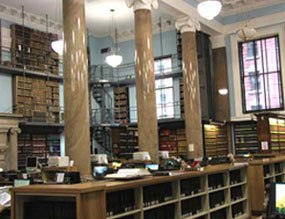
storehouse of legal, economic, social and local history. These displays
from the New York City Bar’s library feature publications that
demonstrate how crimes of passion were sensationalized and marketed.
Nutt, Lizzie. Lizzie Nutt's sad experience :
A heart broken, and a family plunged in grief. Wreck and ruin! The
shooting and tragic death of noble-hearted Captain Nutt, Lizzie's
brave father, who flinched not, like a true soldier, to die in defence
of his daughter's honor. The great Dukes trial at Uniontown, Pa. Full
account, and all "those terrible letters." Philadelphia
: Barclay & Co., 1883.
James Nutt. The very
pathetic and truly remarkable trial of young James Nutt, the avenger
of his father’s death.
Full account from the shooting of Captain Nutt to the death of Dukes
and Trial of the son and brother. Philadelphia: Barclay & Co.
1883
Nicholas L. Dukes, a successful attorney, was engaged to marry Lizzie
Nutt. Dukes manufactured reasons to break his engagement to Lizzie
Nutt by writing anonymous letters to his betrothed’s father,
Captain A.C. Nutt, alleging that his daughter, Lizzie, was “criminally
intimate” with several young men. At an arranged meeting, Dukes
and Nutt scuffled, and Dukes shot the aggrieved father. Fearing that
he would be lynched by the townspeople, Dukes surrendered immediately
claiming self-defense. Everyone thought that Dukes would be convicted,
but a jury, containing many of Nutt’s friends, voted for acquittal.
The judge could not conceal his amazement, admonishing the jury as
he dismissed the prisoner. Duke was subsequently disbarred and after
winning a seat in the Pennsylvania House of Representatives, resigned,
rather than being expelled, when the slanderous assault on Lizzie’s
character was found to be untrue. Soon thereafter, James Nutt, Lizzie’s
brother, and Dukes met on a street by chance. Incited by Dukes’ insults,
James Nutt stalked, shot and killed him. James was eventually acquitted
by reason of insanity.
Fair, Laura . Official report of the trial of
Laura D. Fair, for the murder of Alex. P. Crittenden, including the
testimony, the arguments of counsel, and the charge of the court,
reported verbatim, and the entire correspondence of the parties,
with portraits of the defendant and the deceased. From the short-hand
notes of Marsh and Osbourne, official reporters of the courts.
San Francisco, San Francisco Co-operative Printing Co., 1871.
On November 3, 1870 , Laura Fair fatally shot San Francisco lawyer
Alexander Crittenden, her lover of seven years. Although he represented
himself as single, Fair soon learned that he was married. On the day
of the killing, he was planning to meet his family on a ferry. Fair
followed him there, fired the fatal shot and fled to the boat’s
saloon where she confessed. The defense asserted Fair was temporarily
insane theorizing that she had suffered maniacal attacks due to delayed
menstruation and was unconscious at the time of the shooting. The jury
rejected this unique argument and found Fair guilty of murder, sentencing
her to death. After the State Supreme Court ordered a new trial because
of improperly admitted evidence, Fair was acquitted.
Hughes, John W . The Trial and Execution of Dr. John
W. Hughes, for the murder of Miss Tamzen Parsons: with a sketch of his
life, as related by himself. A record of love, bigamy and murder unparalleled
in the annals of crime. Cleveland , Ohio : Published by John K. Stetler & Co.,
1866.
Seventeen year-old Tamzen Parsons was seduced and fell in love with Dr.
Hughes, a man twice her age. After Hughes showed her a fake divorce
degree, she eloped with him to Pittsburgh. Tamzen’s parents called the police
who promptly arrested Hughes in the couple’s bridal suite. Hughes was
charged with bigamy and sentenced to a year in jail, but was pardoned after
serving five months. Hughes continued to make advances toward Tamzen and
threatened to kill her if she did not marry him. A final confrontation occurred
at the front gate of the Parson house. When Tamzen rebuffed him, Hughes drew
his pistol and shot her twice in the back of the neck, killing her instantly.
After only two hours of deliberation, the jury found him guilty of murder
in the first degree. While in prison, Hughes entertained many sympathetic
and impressionable females, who signed a petition asking that Hughes be spared
from the hangman’s noose. Ignoring their pleas, Governor Jacob Cox
did not commute his death sentence.
Malley, James.The beautiful victim of the Elm City:
being a full, fair, and impartial narrative of all that is known
of the terrible fate of the trusting and unfortunate Jennie E. Cramer:
giving all the evidence that led the jury to hold James Malley, Jr. as
her murderer, and to denounce Walter E. Malley and Blanche Douglass as
aiders and abettors in this social tragedy. New York : M.J. Ivers & Co.,
1881.
James Malley, Jr., nephew of Edward Malley, owner of the successful
Malley's Department Store in New Haven, Ct., was a persistent admirer of
Jennie Cramer. On August 3, Cramer and Malley spent the evening with Walter
Malley, James's cousin, and Walter's friend Blanche Douglass. When Cramer
didn’t return
home her frantic mother questioned the Malley boys and Douglass about
her daughter’s whereabouts. Douglass said that the two had spent
the previous evening at the Elliot Boarding House for Women, but that they
had split up that morning, while the Malleys insisted that they had been
at home and had not been with her daughter. Two witnesses, however, testified
that they had seen Jennie and James together the night she disappeared.
Soon thereafter, Cramer's body was found by a fisherman and an autopsy
revealed that she had been poisoned with laudanum. The Cramer story exploded,
gaining regional attention and appearing repeatedly on the front page of The
New York Times. After a trial of nearly three months, both Malley
boys and Douglass were acquitted. The people of New Haven, still suspicious
of the Malley’s
involvement in the murder ostracized the family and no longer patronized
their store.

Corder, William , An Authentic And Faithful History
Of The Mysterious Murder Of Maria Marten, With A Full Development
Of All The Extraordinary Circumstances Which Led To The Discovery
In The Red Barn ...
London: Thomas Kelly, 1834.
William Corder and Maria Marten kept
their relationship secret until Maria became pregnant. On May 18, 1827,
after leaving her father's cottage for a rendezvous with William, Maria
disappeared. Almost a year later, Maria’s
father discovered his daughter’s body in a shallow grave. William Corder
was arrested, tried, found guilty of murder, and sentenced to death by
hanging. Prior to his execution Corder confessed. The public response
to the murder and trial was ghoulish. Thousands of spectators attended Corder’s
execution despite a heavy rain. Subsequently, his body was cut open and
put on show; his skeleton, scalp and part of his skin were preserved. The participating
surgeon bound an account of the trial in leather made from Corder's skin.
The story formed the basis of the English play and film, Murder in the
Red Barn.

Ruloff, Edward H. Life, trial and execution of Edward
H. Ruloff, the perpetrator of eight murders, numerous burglaries and other
crimes; who was recently hanged at Binghamton, N.Y. ... Philadelphia,
Barclay & co., c1872.
Edward Ruloff murdered his wife and child in 1845
but the state convicted him of abduction of his wife. After serving ten years,
he was then tried for the murder of his child, convicted and sentenced to
hang. He escaped while his appeal was pending. Ironically, the Court of Appeals
reversed his conviction on a technicality; the absence of his daughter’s
corpse. Many years later, in 1870, Ruloff shot and killed a dry goods clerk
during a robbery. Ruloff was tried, convicted and hanged for the murder.
Since no one claimed his body, his head was removed for study at Cornell
University . Body snatchers dug up the rest of his remains.
Clough, Joel. The trial and sentence of Joel Clough: who
was executed on the 26th of July, 1833 for the murder of Mary W. Hamilton,
of Bordentown , N.J. Philadelphia : J. Scarlet, 1833.
Joel Clough was infatuated with Mary Hamilton, the widowed daughter of his
landlord. He twice asked her to marry him, threatening suicide if she refused.
In a fit of anger and frustration when she did not return his affection,
he stabbed her to death. In his statement Clough stated he had not meant
to kill the object of his love, but his passion was so intense that it got
the better of him, and he lost control. The defense counsel unsuccessfully
argued that Clough was temporarily insane.
Chapman, Lucretia . Trial of Lucretia Chapman: otherwise
called Lucretia Espos y Mina, who was jointly indicted with Lino
Amalia Espos y Mina, for the murder of William Chapman, Esq. late of Andalusia,
County of Bucks, Pennsylvania: in the Court of Oyer and Terminer,
held at Doylestown, for Bucks, December term, 1831, continued to February
term, 1832. Philadelphia : G.W. Mentz, 1832. 
Ms. Chapman, with her
young Cuban lover, were charged with conspiracy in the arsenic poisoning
of her husband William, a Pennsylvania schoolmaster. The Chapman trial
pitted the prosecution and the defense against one another as dueling storytellers,
and involved testimony from servants, boarders, Chapman children, pupils
from the school, neighbors, an itinerant bookseller, the family doctor
and clergyman, a pharmacist, a tailor, the undertaker, the Mexican consul
in Philadelphia , police officers and sundry medical experts. The prosecution
took this wealth of information and shaped it into a coherent account
of a woman who committed adultery and murderer in order to marry her foreign
lover. The defense took the same facts and crafted it into a tale of a
devoted wife and mother. Lucretia was found innocent of all charges, but
her lover was convicted of murder.
Sickles, Daniel E . Trial of the Hon. Daniel E. Sickles
for shooting Philip Barton Key ... February 27th, 1859 .
reported by Felix G . New York : R.M. De Witt, 1859. 
Daniel Sickles,
a congressman from New York, was the first man acquitted of a murder charge
on the grounds of temporary insanity. Sickles shot Philip Barton Key, son
of the composer of the Star Spangled Banner, who was having an affair with
Sickles’ wife. Sickles publicly forgave his wife, which
outraged the public that had applauded his role in the shooting. Sickles
became a General in the Civil War, lost a leg at the Battle of Gettysburg
and went on to become Ambassador to Spain.

Hitchcock, Alpheus . The trial of Alpheus
Hitchcock, before the Hon. William W. van Ness, Esq. For the murder
of his wife, by poison, at Sullivan County of Madison, on the third day of
July, 1807. Reported by George Richards, Jun. Utica, New York,, printed by
Seward and Williams, August, 1807.
Alpheus Hitchcock was a voice teacher
who lived in Madison, New York. He was more attentive to one of his young
pupils than his wife. One night, Alpheus stopped at a drug store and purchased
a quantity of arsenic with which he laced his wife's dinner causing her death.
Hitchcock’s motive was very
simple and to the point as he stated in his confession, “I thought
I could live more agreeably with some other woman than my wife.” Alpheus
Hitchcock was the person first to be hanged within Sullivan County.
back to top
|